explore our
Publications

How to be manipulative
Pringle, RM. 2012. How to be manipulative. American Scientist 100:30-37.
Competition, predation, and natural selection in island lizards
Losos, JB and RM Pringle. 2011. Competition, predation, and natural selection in island lizards. Nature 475:E1-2.
Conserving Wildlife in African Landscapes: Kenya’s Ewaso Ecosystem
Pringle, RM, TM Palmer, JR Goheen, DJ McCauley, F. Keesing. 2011. Ecological importance of large herbivores in the Ewaso ecosystem. Pp. 43-53 in NJ Georgiadis (ed), Conserving Wildlife in African Landscapes: Kenya’s Ewaso Ecosystem. Smithsonian Contributions to Zoology No. 632. Smithsonian Institution Scholarly Press, Washington DC.
Encyclopedia of Biological Invasions
Pringle, RM. 2011. Nile perch. Pp. 484-488 in D. Simberloff and M. Rejmánek (eds). Encyclopedia of Biological Invasions. University of California Press, Berkeley, CA.
Synergy of multiple partners, including freeloaders, increases host fitness in a multispecies mutualism.
Palmer, TM, DF Doak, ML Stanton, JL Bronstein, ET Kiers, TP Young, JR Goheen, and RM Pringle. 2010. Synergy of multiple partners, including freeloaders, increases host fitness in a multispecies mutualism. Proc. Natl. Acad. Sci. USA 107:17234-17239.
Spatial pattern enhances ecosystem functioning in an African savanna
Pringle, RM, DF Doak, AK Brody, R Jocqué, and TM Palmer. 2010. Spatial pattern enhances ecosystem functioning in an African savanna. PLOS Biology 8:e1000377. doi:10.1371/journal.pbio.1000377
Review of “Conservation Psychology: Understanding and Promoting Human Care for Nature” by S Clayton and G Myers
Pringle, RM. 2010. Review of “Conservation Psychology: Understanding and Promoting Human Care for Nature” by S Clayton and G Myers. Environmental Conservation 37:222.
Quantifying historical changes in habitat availability for endangered species
Pringle, RM, M Syfert, JK Webb, and R Shine. 2009. Quantifying historical changes in habitat availability for endangered species; use of pixel- and object-based remote sensing. Journal of Applied Ecology 46:544-553.
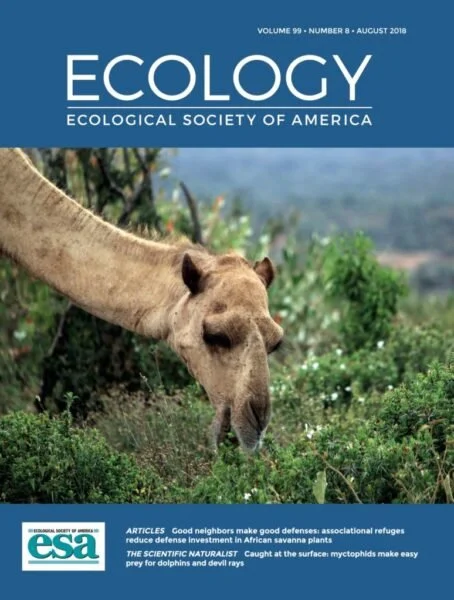
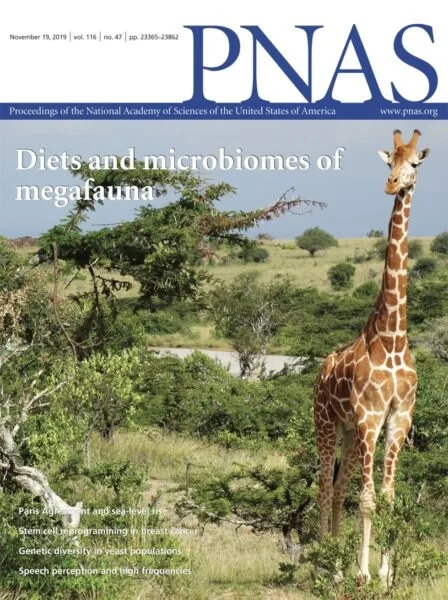
Pringle lab on the cover!